
It is the first question every advertiser asks before getting started on Meta Ads, and often the hardest one to answer.
How much do you need to spend on Facebook and Instagram to get concrete results? Is there a minimum budget? And how do you avoid burning through your budget with no return at all?
Unlike Google Ads, where cost is largely driven by competition on keywords, your Meta Ads budget depends above all on your objective, your target audience and your pixel's ability to feed the algorithm. This guide gives you concrete benchmarks to set your Meta Ads budget wisely.

📌 Recommended reading first
Before reading this article, see what Meta Ads Manager is, how the Meta Ads algorithm works and why your Meta ads don't convert.
€1
Minimum daily budget Meta accepts per ad set
50
Minimum conversion events per week for the algorithm to exit the learning phase
5x
Golden rule: your daily budget should be at least 5 times your target CPA
Why a Meta Ads budget doesn't work like Google Ads
On Google Ads, you pay for clicks on keywords, and the price is set by competition on each search. On Meta Ads, you pay to access an audience, and the price depends on competition to reach that audience at a given moment.
This fundamental difference changes everything about how to approach your budget. On Meta, a budget that is too small doesn't just mean "fewer results": it means the algorithm doesn't have enough data to learn and optimise. Below a certain threshold, you are paying for noise, not performance.
⚠️ The micro-budget trap
Many advertisers start with €5/day "to test". The result: the algorithm doesn't have enough data, the learning phase never ends and the conclusions drawn are wrong. A test on Meta needs enough budget to reach 50 conversions in a week; otherwise the data is not reliable.
Meta Ads CPM: understanding the cost of reaching your audience
On Meta, the base metric is CPM (cost per 1,000 impressions): the price you pay for your ad to be shown 1,000 times to your target audience. Unlike Google Ads CPC, here you pay for exposure, not just for the click.
Meta Ads audience type | Estimated average CPM | Influencing factors |
Broad cold audience (interests) | €3 – €8 | Audience size, time of year |
Lookalike audience | €5 – €12 | Source quality, country |
Website visitor retargeting | €8 – €20 | Audience size, retargeting window |
Buyer / lead retargeting | €10 – €30 | Very small audience, high competition |
Black Friday / Christmas period | +30% to +80% | Annual competition peak |
🔗 See also
How the Meta Ads algorithm decides who sees your ads
Meta Ads: what budget for your advertising goal?
The budget you need on Meta Ads varies considerably depending on what you want to achieve. Awareness, traffic, leads or sales: each goal has its own budget requirements.
Objective | Recommended monthly budget | What you can expect |
Awareness / Reach | €100 to €300/month | Local visibility, brand awareness |
Website traffic | €200 to €500/month | Qualified visitors, pixel data |
Lead generation | €500 to €1,500/month | Regular leads if target CPA ≤ €30 |
E-commerce sales | €800 to €3,000/month | Positive ROAS if creative and pixel are optimised |
Scale / growth | €3,000 – €10,000+ | Volume + Advantage+ automation |
The 5x rule: how to calculate your minimum Meta Ads budget
As we saw in our article on why your Meta Ads don't convert, the algorithm needs data to learn. The 5x rule is the simplest way to calculate a minimum viable daily budget.
✅ The 5x rule explained
Minimum daily budget = target CPA × 5
If your target CPA is €20 (you want to acquire a lead for €20), your minimum daily budget is €100. Below that, Meta doesn't generate enough data to optimise effectively, and your real cost per conversion will be well above your target.
Example calculations by business type
Business type | Estimated target CPA | Min. daily budget | Min. monthly budget |
Coach / Consultant | €15 to €30 / lead | €75 to €150/day | €2,250 – €4,500 |
Fashion e-commerce | €8 to €20 / purchase | €40 to €100/day | €1,200 – €3,000 |
SaaS / B2B software | €30 to €80 / lead | €150 to €400/day | €4,500 – €12,000 |
Restaurant / Local | €3 to €8 / action | €15 to €40/day | €450 – €1,200 |
Online training | €10 to €25 / sign-up | €50 to €125/day | €1,500 – €3,750 |
🔴 What these numbers really mean
These budgets may seem high. They reflect the real cost of algorithmic learning on Meta. If your budget doesn't allow you to meet the 5x rule, start with a traffic or engagement objective to build up pixel data, then switch to conversions once the pixel is warm.
ABO vs CBO: which budget structure should you choose on Meta Ads?
Meta offers two ways of splitting your budget between your ad sets.
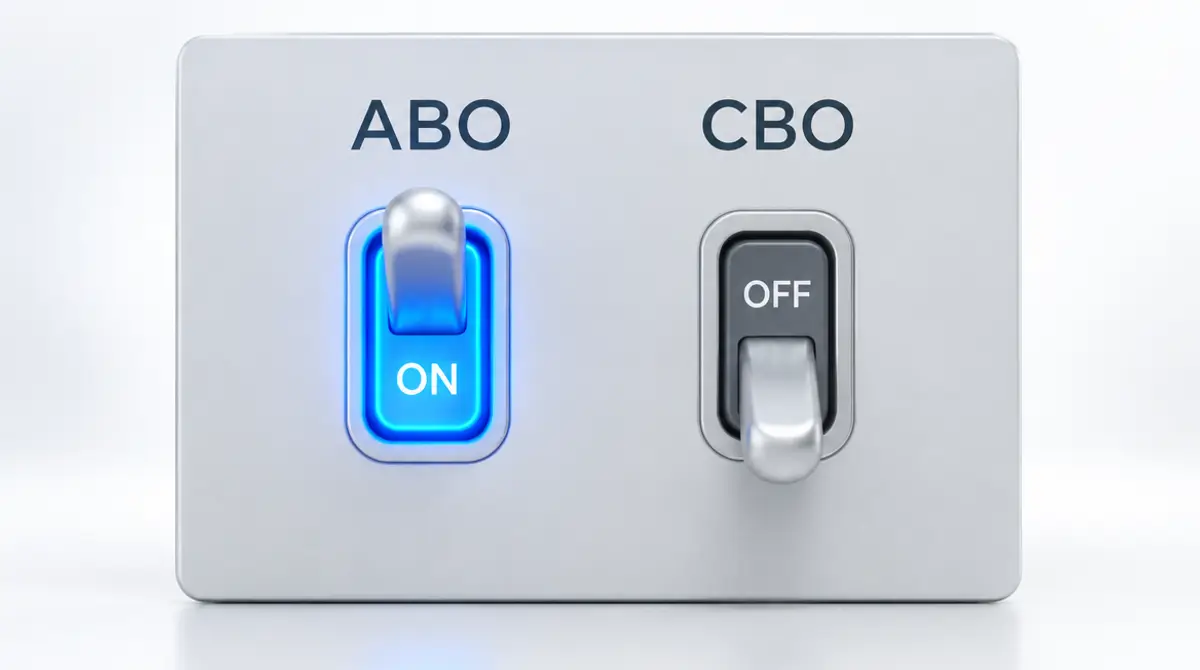
ABO: budget at ad set level
You set a fixed budget for each ad set. Advantage: full control over allocation. Drawback: you have to identify and switch off underperforming ad sets manually.
CBO: budget at campaign level
Meta automatically distributes your total budget between your ad sets based on real-time performance. Advantage: the algorithm optimises the allocation. Drawback: one ad set can take most of the budget if the others are less mature.
💡 Which structure should you choose?
ABO → best in the testing phase, to compare audiences or creatives with controlled budgets
CBO → best in the scaling phase, when your ad sets are validated and you want to let the algorithm optimise
Checklist: setting your Meta Ads budget properly before launch
My target CPA is defined before I set my budget
My daily budget follows the 5x rule (≥ 5 × target CPA)
My pixel reports the right conversion events to feed the algorithm
I have chosen between ABO and CBO based on my phase (test vs scale)
I have planned extra budget for seasonal peaks (Black Friday, Christmas)
I don't change my campaigns during the first 7 days
If my budget doesn't allow the 5x rule, I start with a traffic/engagement objective
Not sure what Meta Ads budget to plan for your business?
A free audit gives you an accurate estimate based on your sector, your goals and the real level of competition for your audience.
Request a free audit